If you use an online booking system, sooner or later the question comes up: is it worth asking guests for an online payment or deposit when booking? The answer isn't black and white — for some services it's a huge help, for others an unnecessary complication.
In this article, we'll walk through how when, how much, and how it's worth asking for — and when it's better to stick with the simple booking + reminder combination.
Why is it worth offering online payment?
Online payment isn't just about collecting money. It has three main benefits:
- Reduces the no-show rate. If the guest has already paid — even just a partial amount — they take the appointment much more seriously. Experience shows that deposit payment reduces no-shows by 40-60%.
- Less administration. You don't have to handle cash or do the math at the end. Payment happens automatically, so you can focus on your work.
- More predictable revenue. If you can already see at the start of the week that the deposits for bookings have arrived, you can be more confident guests will actually show up.
When is it worth asking for a deposit?
A deposit isn't justified everywhere. Here are the situations where it makes the most sense:
Longer services (60+ minutes). Losing a 90-minute massage, a 2-hour photo shoot or a complex cosmetic treatment is a significant loss of revenue. The deposit ensures the guest is committed.
More expensive services (over 10,000 Ft). The more expensive the service, the more painful a no-show. A 5,000 Ft haircut is somewhat forgivable, but missing a 40,000 Ft wedding makeup appointment is already a serious loss.
Weekend and peak time slots. Weekend bookings are especially valuable — if someone doesn't show up, you can't move that Saturday afternoon slot to Monday. The deposit protects these valuable slots.
New guests. Returning guests are generally reliable — they already know you, and if they can't make it, they let you know. New guests don't have that trust relationship yet, so a deposit helps filter out non-serious bookings.
Seasonal peak periods. Before Christmas, at graduation time, during wedding season, demand is high, and a cancellation hurts twice as much: not only do you lose revenue, you also turned away someone else for that slot. This is when a deposit is especially warranted.
How much should you ask as a deposit?
There's no single right answer, but there are some best practices:
- 20-30% is the "soft" deposit — enough to secure commitment, but not enough to scare people off. For a 15,000 Ft service, that's 3,000-4,500 Ft.
- 50% is the "medium" deposit — common for more expensive and longer services. Frequent for photo shoots, complex treatments.
- 100% upfront payment — less common, but for example completely accepted for online consultations, workshops, or highly sought-after time slots.
Tip: Start lower (20-30%), and if the no-show rate doesn't drop enough, increase it gradually. In AI Booking you can set the deposit amount separately per service — so you don't need to ask for a deposit for a quick haircut, but you do for a 2-hour bridal makeup session.
How does Stripe payment work in AI Booking?
AI Booking uses Stripe to handle payments. Stripe is one of the most trusted payment providers in the world — Shopify, Booking.com and many other major platforms use it as well.
From the guest's perspective, the process is simple:
- Selects the service and time slot in the on the online booking interface.
- Provides their name and contact details.
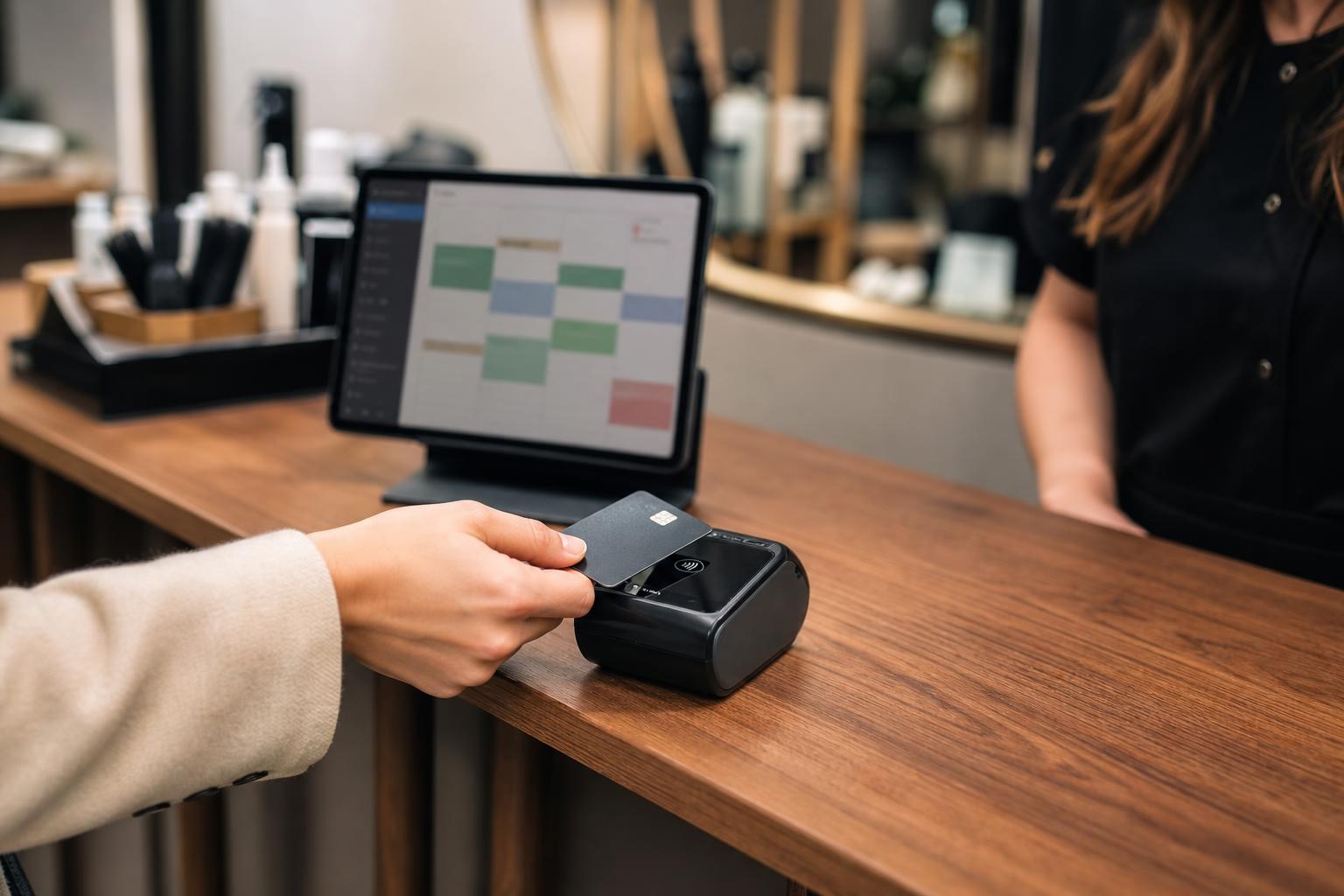
- On the payment page, you enter your card details.
- The deposit is deducted automatically and the booking is confirmed.
- You will receive a confirmation email about the booking and payment.
The guest doesn't need to create a Stripe account — a simple card payment that takes 30 seconds. Visa, Mastercard and most European cards are accepted.
From your perspective: Stripe transfers the money directly to your bank account, typically within 2-7 business days. Stripe's fee is 1.5% + 25 Ft per transaction (for EU cards) — for a 5,000 Ft deposit, that's 100 Ft.
For which services is it worth it? — Industry examples
Hairdresser: It's not common to request a deposit for a simple haircut — guests would find it hard to accept, and the amount doesn't justify it. However, for bridal hairstyling, complex coloring, or multi-hour treatments (e.g. balayage), a 30-50% deposit is fully justified.
Beauticians, nail techs: For short treatments (manicure, eyebrows), the Reminder is enough. For longer treatments (gel builds, complex facials), a deposit reduces losses from cancellations.
Photographer: For photography, a deposit is almost an industry standard. 30-50% deposit at booking, the rest on the day of the shoot or at delivery. This protects the photographer, because losing a weekend slot also means losing another potential booking.
Masseur: For individual massages, a 20-30% deposit is recommended, especially on weekends and evenings. If the guest is a regular (comes weekly), a reminder is enough.
Yoga instructor, trainer: For personal training, a deposit is common — the guest takes it seriously because they've already paid for it. For group classes, a package or ticket system is more practical.
Consultant, therapist: For online consultations, 100% upfront payment is common, since a lost slot can't be filled retroactively, and it's also more convenient for the guest not to deal with payment afterward.
When should you not push for a deposit?
A deposit isn't always a good idea. There are situations where it causes more harm than good:
- Short, low-value services. Asking for a 600 Ft deposit on a 3,000 Ft haircut is ridiculous — the guest will just go elsewhere, where booking is simpler.
- Returning, reliable guests. If someone has been visiting you every two weeks for 2 years, a deposit can feel insulting. Reserve it for new guests or pricier services.
- In a local, highly competitive market. If the salon next door doesn't ask for a deposit, some of your guests might switch over. Consider the market situation.
- Fast, impulsive bookings. If the guest books an appointment within 2 hours, a deposit is an unnecessary obstacle — they clearly want to come if they're booking for this afternoon now.
The good solution: set it per service, where you require a deposit and where you don't. AI Booking makes this possible — you don't have to handle everything the same way.
Refund and cancellation
With deposit payments comes the question: what happens if the guest cancels the booking?
Most providers apply the following simple rule:
- Cancellation more than 24 hours before the appointment: full refund
- Cancellation within 24 hours: the deposit is non-refundable
- No-show: the deposit is non-refundable
It's worth communicating this clearly both on the booking interface and in the confirmation email. Guests generally accept this — it's a fair rule if they know in advance.
Frequently asked questions about online payment
Is card payment secure?
Yes. Stripe holds PCI DSS Level 1 certification — the highest level of payment security standard. Card data is sent encrypted directly to Stripe — neither you nor AI Booking store it.
Can every guest pay online?
Most Hungarian bank cards work. Visa, Mastercard, and in some cases Maestro are accepted. Apple Pay and Google Pay are also supported.
How much does Stripe cost me?
Stripe charges 1.5% + 25 Ft per transaction for EU cards. For a 10,000 Ft deposit that's 175 Ft — less than the bank cost of a cash transaction.
Can I get an invoice for the Stripe fee?
Yes. Stripe sends a monthly summary of the deducted fees, which can be used for accounting.
Is online payment also available in the free plan?
Online payment is available in the paid plans. The free plan is automatic reminders and the Google Calendar sync it contains.
Summary
Online payment and deposits are not a miracle cure, but when applied in the right situation reduces no-shows, simplifies administration and makes your revenue more predictable. A kulcs: ne mindenhol erőltesd, hanem ott alkalmazd, ahol valódi hozzáadott értéket jelent.
Three simple steps to get started:
- Identify the high-risk services — longer duration, higher price, a slot that's hard to refill.
- Set a 20-30% deposit to these services.
- Communicate your cancellation policy clearly (24-hour limit).
For the other services, stick with the for reminders — and if the your booking widget is on your website, guests can conveniently book and pay in one place.
Try AI Booking
14-day free trial, no credit card needed. Online payment with Stripe, automatic reminders, Google Calendar sync — manage everything from one place. Hungarian-language interface, Hungarian invoicing, Hungarian customer support.
Start free trial →