A pass or multi-session package is one of the best ways to turn a one-time booking into a returning guest. Selling a 10-session package brings in a larger sum immediately, while committing the guest for the coming weeks or months. This isn't a trick — it's an established practice among service providers that works in nearly every industry: yoga instructors, massage therapists, beauticians, personal trainers, physiotherapists, hairdressers, even business coaches.
The question isn't whether whether it's worth selling a pass or package — but rather that how it's worth it. Because if you price it wrong or don't have proper records behind it, it does more harm than good. In this article, we'll go through when it works, how to price it well, what psychology lies behind it, and what needs to be solved technically so it doesn't become a headache.
What is a subscription or package good for in a service business?
A membership package delivers three things at once that a single-session sale lacks:
Revenue collected in advance. For a 10-session yoga pass, the guest pays now, and you receive the money now — not spread over 10 weeks, session by session, in cash. That's a huge difference for cash flow, especially if you have rent or staff salaries due at the start of the month.
Commitment. Someone who has paid for ten sessions in advance will show up for all ten. They won't skip or postpone, because their money is already committed. This automatically turns them into a returning guest and reduces the chance they'll try the competition.
Higher average guest value. A guest who buys a pass spends more with you over a year, on average, than one who books occasionally. This isn't a coincidence: the pass sets a budget the guest wants to use up — and often exceeds, because they become used to the service.
There is also a fourth benefit that few people talk about: your calendar is more predictable. If you have 30 active pass holders who come about once a week, you can count on 30 fixed bookings a week — without advertising anything.
When it makes sense to introduce a package pass — and when it doesn't
Not every service suits a subscription. The right question is: is your service recurring by nature?
Yes, introduce a package if:
- The guest naturally returns monthly or weekly (yoga, massage, fitness, beauty, physiotherapy, nail care).
- A single session alone doesn't produce visible results — only a series of sessions does (rehabilitation, body shaping, skin treatment, coaching).
- Your guests themselves ask "couldn't this be a bit cheaper?" — that's a sign of demand for a package deal.
Don't push a membership pass if:
- Your service is festive or occasion-based (wedding photography, birthday makeup, special events).
- Guests are likely to switch after 1-2 sessions, since it's not a long process.
- Your pricing is already premium and your guests treat every visit as its own "experience" — here a pass could devalue the service.
And most are somewhere in between: a package trial can be launched with a single plan, and in three to six months you can decide whether it's worth expanding or dropping.
How should you price a 5- or 10-session package?
The biggest mistake in pass pricing is giving either too big a discount (chipping away at your own revenue) or too small a one (and nobody buys a pass because it's not worth it). In practice, three pricing models work well:
1. The "pay for one, get one free" model. This is the classic 5+1 or 10+2 scheme. Psychologically strong, because the guest feels they're getting a gift. Numerically it's about a 15-20% discount compared to the unit price. This is the easiest entry price, especially when launching a new pass system.
2. The "round percentage" model. 10% discount on a 5-session package, 15% on a 10-session package, 20% on a 20-session package. Simple, clear, and the guest can quickly calculate the savings. This is the most "magazine-style" approach, recommended for fitness studios and massage salons.
3. The "tiered" model. You raise the price of the smaller package slightly, and discount the larger package more aggressively. For example, a 5-session package with only 10% discount, while the 10-session package gets 25%. This steers the guest toward the larger package — more revenue, better commitment.
Whichever you choose, three basic rules always apply:
- The discount should never exceed 30%. With a discount larger than this, you'll end up converting your existing single-visit guests to passes too — and overall lose revenue.
- The pass price should be a round number. 28,000 Ft sounds much better than 27,450 Ft. Let's not decimate the marketing psychology with overly precise math.
- Always set an expiration date. We will return to this in the next point.
Subscription psychology: why do guests keep coming back?
A pass is not just a pricing tool — it's also a behavior-shaping tool. The psychology behind it is simple but very powerful: people don't like losing what they've already paid for. Behavioural economics calls this the “commitment effect” (commitment bias).
When your guest pays 28,000 Ft for a 10-session yoga pass, from then on every unused session feels like a painful loss to them. This motivates them to come even when they could otherwise skip it. In the long run this gets the guest used to regularity — and your service becomes part of their weekly routine.
There's a downside to this effect worth watching for: if your guest feels they can't make full use of the pass (no availability, can't find a free slot, life got in the way), then instead of becoming a returning guest, the guest as a disappointed returning visitor leaves. That's why it's critical to include with the pass:
- A realistic expiry period. 3 months tends to work well for a 5-session pass, 4-6 months for 10 sessions, and 1 year for 20 sessions.
- A clear booking process. Let guests see in advance when there's a free slot and book it in just a few clicks.
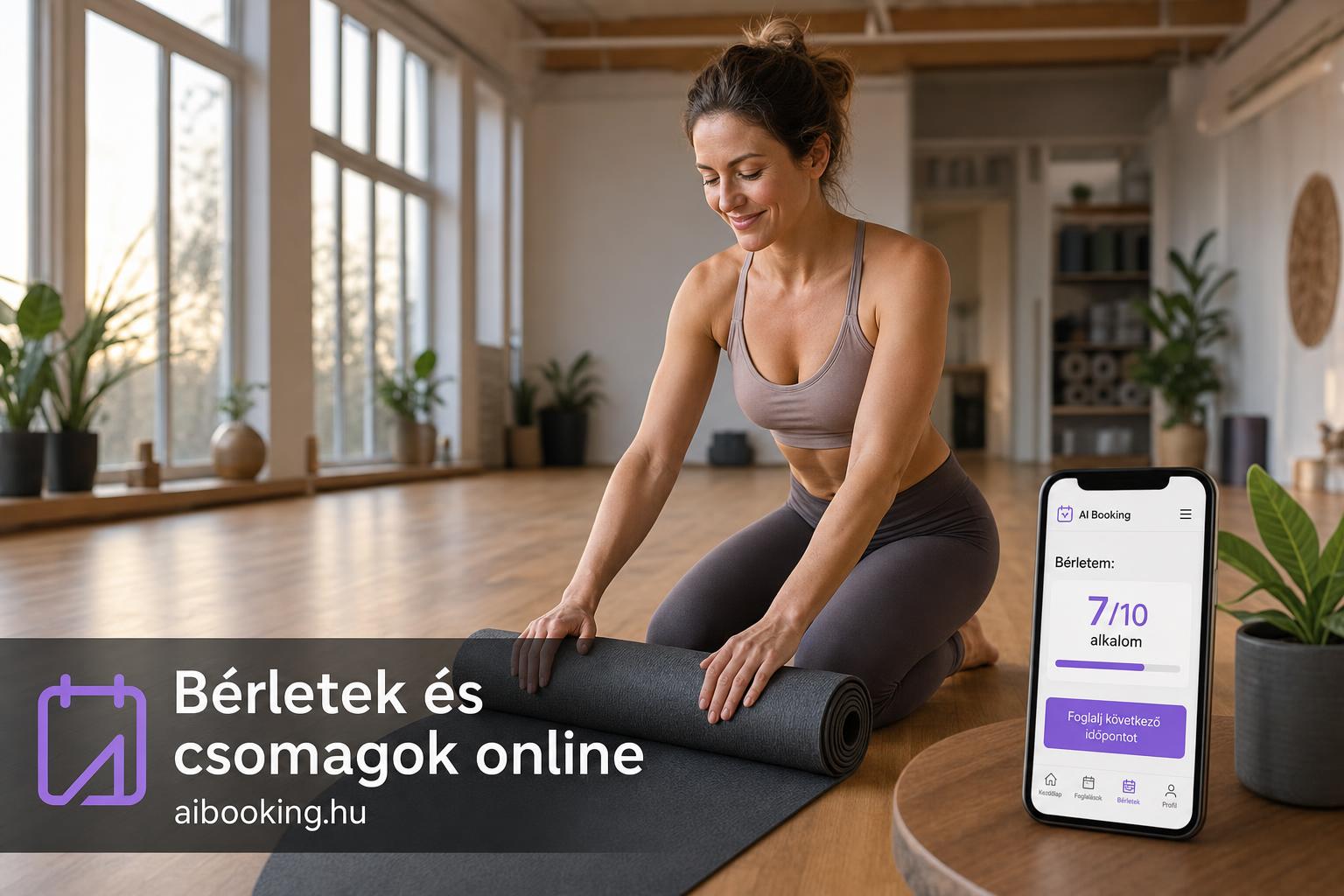
- A transparent balance. The guest always knows how many sessions are left on their pass.
What needs to be solved technically for pass management?
Behind a well-functioning pass system, five things need to be solved:
1. Pass balance tracking. You need to know, for every guest, how many sessions remain on their pass and when it expires. A simple spreadsheet can handle this — but once you have 10-20 active passes, tracking it manually starts to become painful.
2. Automatic deduction with every booking. When the guest books, one session should be automatically deducted from their pass — no need to track it manually afterward.
3. Simple purchase and recording. The guest pays for the pass once (on site or by bank transfer), you record it in the system in one step, and from then on one session is deducted automatically with every booking. No need to track the remaining sessions on paper or in a spreadsheet.
4. Managing expired packages. What happens if the guest couldn't use up the pass before it expired? Can it be extended? Replaced? Refunded? Have a rule set for these and communicate it in advance.
5. Invoice for the pass purchase. As a Hungarian business, you must issue an official invoice for every pass purchase — automatically, linked to a Hungarian invoicing program. Nobody wants to write invoices by hand for every pass.
The first three points can be solved manually, but for an active service provider that's already 30-60 minutes of daily admin. The fourth and fifth points, however, can practically only scale with a system — if you try manually, you'll either get errors or a tax authority problem.
AI Booking and package management: what it takes off your plate
Az AI Booking a Hungarian-language online booking system that we develop specifically for service providers. Pass and package management is among the supported features — in the wellness, yoga, physiotherapy, and coaching categories, it was a specific consideration that passes, packages, and combo offers could also be sold through it.
The system handles the booking process, payment and invoicing in one place. The integrations important for membership-pass management are:
- Pass with a one-time payment: the guest pays for the pass once, on site or by bank transfer. You record it in the system, and one session is deducted automatically with every booking.
- Hungarian invoicing: Billingo or Számlázz.hu integration for issuing invoices and receipts.
- Two-way Google Calendar sync: booked appointments also appear in your own Google Calendar, so double bookings can't happen.
- Automatic reminders: your guest gets an email and SMS reminder before the pass-based booking — fewer no-shows, better pass utilization.
- 14-day free trial without a bank card, with Hungarian customer support.
If you'd like to read more about related topics, it's worth checking out the about reducing no-shows, the online payment and deposit about its use, as well as the about Google Calendar sync earlier articles on the topic — all of them touch on the daily practice of managing memberships.
Common mistakes — worth avoiding
These are the five mistakes most providers make when introducing passes or packages for the first time. You can avoid all of them if you know about them in advance.
Too big a discount for the start. Many think a 30-40% pass discount is a strong marketing move. In practice, it also converts your existing pay-per-visit guests to passes — and your total revenue drops. Stay between 15-25%.
A pass with no expiration date. Without an expiry date, the guest never feels they "need to use" the pass. A year later they show up saying "I still have three sessions left" — right when that slot is already a fixed booking for you. Always set a realistic expiry.
Pass refund with unclear rules. If it's not communicated in advance how long a pass can be refunded and under what conditions, at the first conflict you'll lose either the guest or your own money. Write it down, and communicate it on your site and in the pass purchase flow.
Manual records above 20 guests. An Excel spreadsheet still works up to about the 10th active pass. After that you start accumulating errors, double deductions, missed invoices. If you're serious about selling passes, think in terms of a system from the start.
A hidden pass offer. If guests only learn about the pass when they ask, they won't buy it at the best moment (after the first session or at a cancellation). Show the pass offer on your booking page and in the service description, and make paying simple: on site or by bank transfer.
Try AI Booking
14-day free trial, no credit card required. Hungarian-language interface, Hungarian invoicing, Hungarian customer support. Pass and package sales are among the supported features — for yoga, wellness, fitness, beauty, physiotherapy, and coaching alike.
Start free trial →